 |
Thermal-FIST 1.6.1
Package for hadron resonance gas model applications
|
Loading...
Searching...
No Matches
|
Thermal-FIST 1.6.1
Package for hadron resonance gas model applications
|
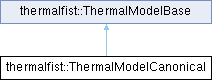
Class implementing the HRG model in the canonical ensemble. More...
#include <ThermalModelCanonical.h>
Public Member Functions | |
| ThermalModelCanonical (ThermalParticleSystem *TPS, const ThermalModelParameters ¶ms=ThermalModelParameters()) | |
| Construct a new ThermalModelCanonical object. | |
| virtual | ~ThermalModelCanonical (void) |
| Destroy the ThermalModelCanonical object. | |
| virtual void | CalculateQuantumNumbersRange (bool computeFluctuations=false) |
| Calculates the range of quantum numbers values for which it is necessary to compute the canonical partition functions. | |
| virtual void | CalculatePartitionFunctions (double Vc=-1.) |
| Calculates all necessary canonical partition functions. | |
| virtual bool | IsParticleCanonical (const ThermalParticle &part) |
| Determines whether the specified ThermalParticle is treat canonically or grand-canonically in the present setup. | |
| virtual void | ConserveBaryonCharge (bool conserve=true) |
| Specifies whether the baryon number is treated canonically. | |
| virtual void | ConserveElectricCharge (bool conserve=true) |
| Specifies whether the electric charge is treated canonically. | |
| virtual void | ConserveStrangeness (bool conserve=true) |
| Specifies whether the strangeness charge is treated canonically. | |
| virtual void | ConserveCharm (bool conserve=true) |
| Specifies whether the charm charge is treated canonically. | |
| virtual bool | IsConservedChargeCanonical (ConservedCharge::Name charge) const |
| virtual double | GetGCEDensity (int i) const |
| Density of particle species i in the grand-canonical ensemble. | |
| int | IntegrationIterationsMultiplier () const |
| The multiplier of the number of iterations in the numerical integration. | |
| void | SetIntegrationIterationsMultiplier (int multiplier) |
| Assigns the multiplier of the number of iterations in the numerical integration. | |
| CanonicalMethod | Method () const |
| Returns the method used for computing the canonical partition functions. | |
| void | SetMethod (CanonicalMethod method) |
| Sets the method for computing the canonical partition functions. | |
| void | SetModelGCE (ThermalModelBase *model) |
| Sets an external GCE model to use in the saddle-point approach. | |
| virtual void | ResetCalculatedFlags () |
| void | ResetPartialZCalculated () |
| bool | IsPartialZCalculated () const |
| bool | IsPartialZCalculatedFlucts () const |
| void | ChangeTPS (ThermalParticleSystem *TPS) |
| Change the particle list. | |
| virtual void | SetStatistics (bool stats) |
| virtual void | FixParameters () |
| Method which actually implements ConstrainChemicalPotentials() (for backward compatibility). | |
| virtual void | FixParametersNoReset () |
| Method which actually implements ConstrainChemicalPotentialsNoReset() (for backward compatibility). | |
| void | SolveChemicalPotentialsGCE (bool resetInitialValues) |
| virtual void | CalculatePrimordialDensities () |
| Calculates the primordial densities of all species. | |
| virtual void | ValidateCalculation () |
| Checks whether issues have occured during the calculation of particle densities in the CalculateDensities() method. | |
| virtual double | ParticleScaledVariance (int part) |
| virtual void | CalculateTwoParticleCorrelations () |
| Computes the fluctuations and correlations of the primordial particle numbers. | |
| virtual void | CalculateFluctuations () |
| Computes the fluctuation observables. | |
| virtual double | CalculateEnergyDensity () |
| virtual double | CalculatePressure () |
| virtual double | CalculateEntropyDensity () |
| virtual double | CalculateEnergyDensityDerivativeT () |
| virtual double | CalculateEntropyDensityDerivativeT () |
| virtual double | ParticleScalarDensity (int) |
| Returns the scalar density of a particle species. | |
 Public Member Functions inherited from thermalfist::ThermalModelBase | |
| ThermalModelBase (ThermalParticleSystem *TPS, const ThermalModelParameters ¶ms=ThermalModelParameters()) | |
| Construct a new ThermalModelBase object. | |
| virtual | ~ThermalModelBase (void) |
| int | ComponentsNumber () const |
| Number of different particle species in the list. | |
| virtual void | FillVirial (const std::vector< double > &ri=std::vector< double >(0)) |
| Fills the excluded volume coefficients \( \tilde{b}_{ij} \) based on the provided radii parameters for all species. | |
| bool | UseWidth () const |
| Whether finite resonance widths are considered. | |
| void | SetUseWidth (bool useWidth) |
| Sets whether finite resonance widths are used. Deprecated. | |
| void | SetUseWidth (ThermalParticle::ResonanceWidthIntegration type) |
| Sets the finite resonance widths scheme to use. | |
| void | SetNormBratio (bool normBratio) |
| Whether branching ratios are renormalized to 100%. | |
| bool | NormBratio () const |
| void | SetOMP (bool openMP) |
| OpenMP support. Currently not used. | |
| virtual void | SetParameters (const ThermalModelParameters ¶ms) |
| The thermal parameters. | |
| const ThermalModelParameters & | Parameters () const |
| void | UpdateParameters () |
| Calls SetParameters() with current m_Parameters. | |
| virtual void | SetTemperature (double T) |
| Set the temperature. | |
| virtual void | SetBaryonChemicalPotential (double muB) |
| Set the baryon chemical potential. | |
| virtual void | SetElectricChemicalPotential (double muQ) |
| Set the electric chemical potential. | |
| virtual void | SetStrangenessChemicalPotential (double muS) |
| Set the strangeness chemical potential. | |
| virtual void | SetCharmChemicalPotential (double muC) |
| Set the charm chemical potential. | |
| virtual void | SetGammaq (double gammaq) |
| Set the light quark fugacity factor. | |
| virtual void | SetGammaS (double gammaS) |
| Set the strange quark fugacity factor. | |
| virtual void | SetGammaC (double gammaC) |
| Set the charm quark fugacity factor. | |
| virtual void | SetBaryonCharge (int B) |
| Set the total baryon number (for canonical ensemble only) | |
| virtual void | SetElectricCharge (int Q) |
| Set the total electric charge (for canonical ensemble only) | |
| virtual void | SetStrangeness (int S) |
| Set the total strangeness (for canonical ensemble only) | |
| virtual void | SetCharm (int C) |
| Set the total charm (for canonical ensemble only) | |
| virtual void | SetRadius (double) |
| Set the same excluded volume radius parameter for all species. | |
| virtual void | SetRadius (int, double) |
| Set the radius parameter for particle species i. | |
| virtual void | SetVirial (int, int, double) |
| Set the excluded volume coefficient \( \tilde{b}_{ij} \). | |
| virtual void | SetRepulsion (int i, int j, double b) |
| Same as SetVirial() but with a more clear name on what is actually does. | |
| virtual void | SetAttraction (int, int, double) |
| Set the vdW mean field attraction coefficient \( a_{ij} \). | |
| virtual void | DisableMesonMesonVirial () |
| void | DisableMesonMesonRepulsion () |
| virtual void | DisableMesonMesonAttraction () |
| virtual void | DisableMesonBaryonVirial () |
| void | DisableMesonBaryonRepulsion () |
| virtual void | DisableMesonBaryonAttraction () |
| virtual void | DisableBaryonBaryonVirial () |
| void | DisableBaryonBaryonRepulsion () |
| virtual void | DisableBaryonBaryonAttraction () |
| virtual void | DisableBaryonAntiBaryonVirial () |
| void | DisableBaryonAntiBaryonRepulsion () |
| virtual void | DisableBaryonAntiBaryonAttraction () |
| virtual void | ReadInteractionParameters (const std::string &) |
| Reads the QvdW interaction parameters from a file. | |
| virtual void | WriteInteractionParameters (const std::string &) |
| Write the QvdW interaction parameters to a file. | |
| virtual double | VirialCoefficient (int, int) const |
| Excluded volume coefficient \( \tilde{b}_{ij} = 0 \). | |
| double | RepulsionCoefficient (int i, int j) const |
| virtual double | AttractionCoefficient (int, int) const |
| QvdW mean field attraction coefficient \( a_{ij} \). | |
| bool | QuantumStatistics () const |
| virtual void | SetCalculationType (IdealGasFunctions::QStatsCalculationType type) |
| Sets the CalculationType() method to evaluate quantum statistics. Calls the corresponding method in TPS(). | |
| virtual void | SetClusterExpansionOrder (int order) |
| Set the number of terms in the cluster expansion method. Calls the corresponding method in TPS(). | |
| void | SetResonanceWidthShape (ThermalParticle::ResonanceWidthShape shape) |
| Set the ThermalParticle::ResonanceWidthShape for all particles. Calls the corresponding method in TPS(). | |
| void | SetResonanceWidthIntegrationType (ThermalParticle::ResonanceWidthIntegration type) |
| Set the ThermalParticle::ResonanceWidthIntegration scheme for all particles. Calls the corresponding method in TPS(). | |
| virtual void | FillChemicalPotentials () |
| Sets the chemical potentials of all particles. | |
| virtual void | SetChemicalPotentials (const std::vector< double > &chem=std::vector< double >(0)) |
| Sets the chemical potentials of all particles. | |
| const std::vector< double > & | ChemicalPotentials () const |
| A vector of chemical potentials of all particles. | |
| double | ChemicalPotential (int i) const |
| Chemical potential of particle species i. | |
| virtual void | SetChemicalPotential (int i, double chem) |
| Sets the chemical potential of particle species i. | |
| virtual double | FullIdealChemicalPotential (int i) const |
| Chemical potential entering the ideal gas expressions of particle species i. | |
| bool | ConstrainMuB () const |
| void | ConstrainMuB (bool constrain) |
| bool | ConstrainMuQ () const |
| void | ConstrainMuQ (bool constrain) |
| bool | ConstrainMuS () const |
| void | ConstrainMuS (bool constrain) |
| bool | ConstrainMuC () const |
| void | ConstrainMuC (bool constrain) |
| bool | ConstrainGammaC () const |
| void | ConstrainGammaC (bool constrain) |
| Sets whether gammaC is constrained from target Nccbar. | |
| void | SetNccbar (double Nccbar) |
| The target number of cc-bar pairs to be used to constrain gammaC. | |
| double | NccbarGoal () const |
| void | UsePartialChemicalEquilibrium (bool usePCE) |
| Sets whether partial chemical equilibrium with additional chemical potentials is used. | |
| bool | UsePartialChemicalEquilibrium () |
| Whether partial chemical equilibrium with additional chemical potentials is used. | |
| void | SetSoverB (double SB) |
| The entropy per baryon ratio to be used to constrain the baryon chemical potential. | |
| double | SoverB () const |
| void | SetQoverB (double QB) |
| The electric-to-baryon charge ratio to be used to constrain the electric chemical potential. | |
| double | QoverB () const |
| void | SetVolume (double Volume) |
| Sets the system volume. | |
| double | Volume () const |
| System volume (fm \(^3\)) | |
| void | SetVolumeRadius (double R) |
| Sets the system radius. | |
| double | CanonicalVolume () const |
| The canonical correlation volume V \(_c\) (fm \(^3\)) | |
| void | SetCanonicalVolume (double Volume) |
| Set the canonical correlation volume V \(_c\). | |
| void | SetCanonicalVolumeRadius (double Rc) |
| Set the canonical correlation system radius. | |
| void | ConstrainChemicalPotentials (bool resetInitialValues=true) |
| Constrains the chemical potentials \( \mu_B,\,\mu_Q,\,\mu_S,\,\mu_C \) by the conservation laws imposed. | |
| virtual bool | SolveChemicalPotentials (double totB=0., double totQ=0., double totS=0., double totC=0., double muBinit=0., double muQinit=0., double muSinit=0., double muCinit=0., bool ConstrMuB=true, bool ConstrMuQ=true, bool ConstrMuS=true, bool ConstrMuC=true) |
| The procedure which calculates the chemical potentials \( \mu_B,\,\mu_Q,\,\mu_S,\,\mu_C \) which reproduce the specified total baryon, electric, strangeness, and charm charges of the system. | |
| virtual bool | FixChemicalPotentialsThroughDensities (double rhoB=0., double rhoQ=0., double rhoS=0., double rhoC=0., double muBinit=0., double muQinit=0., double muSinit=0., double muCinit=0., bool ConstrMuB=true, bool ConstrMuQ=true, bool ConstrMuS=true, bool ConstrMuC=true) |
| The procedure which calculates the chemical potentials \( \mu_B,\,\mu_Q,\,\mu_S,\,\mu_C \) which reproduce the specified baryon, electric, strangeness, and charm densities. | |
| virtual void | CalculateDensities () |
| Calculates the primordial and total (after decays) densities of all species. | |
| std::string | ValidityCheckLog () const |
| All messaged which occured during the validation procedure in the ValidateCalculation() method. | |
| virtual void | CalculateDensitiesGCE () |
| Calculates the particle densities in a grand-canonical ensemble. | |
| virtual void | CalculateFeeddown () |
| Calculates the total densities which include feeddown contributions. | |
| virtual void | CalculateTemperatureDerivatives () |
| Computes the temperature derivatives of densities, shifted chemical potentials, and primordial hadron number susceptibilities. | |
| virtual void | CalculateTwoParticleFluctuationsDecays () |
| Computes particle number correlations and fluctuations for all final-state particles which are marked stable. | |
| virtual void | ApplyBaryonAnnihilation (double gammaBbar) |
| [EXPERIMENTAL] Applies a baryon annihilation toy model to baryon yields and susceptibilities with the given gammaBbar. | |
| virtual double | TwoParticleSusceptibilityPrimordial (int i, int j) const |
| Returns the computed primordial particle number (cross-)susceptibility \( \frac{1}{VT^3} \, \langle \Delta N_i \Delta N_j \rangle \) for particles with ids i and j. CalculateFluctuations() must be called beforehand. | |
| virtual double | TwoParticleSusceptibilityPrimordialByPdg (long long id1, long long id2) |
| Returns the computed primordial particle number (cross-)susceptibility \( \frac{1}{VT^3} \, \langle \Delta N_i \Delta N_j \rangle \) for particles with pdg codes id1 and id2. CalculateFluctuations() must be called beforehand. | |
| virtual double | TwoParticleSusceptibilityTemperatureDerivativePrimordial (int i, int j) const |
| Returns the computed temperature derivative of the primordial particle number (cross-)susceptibility \( \frac{\partial}{\partial T} \frac{1}{VT^3} \, \langle \Delta N_i \Delta N_j \rangle \) for particles with ids i and j. CalculateFluctuations() must be called beforehand. | |
| virtual double | TwoParticleSusceptibilityTemperatureDerivativePrimordialByPdg (long long id1, long long id2) |
| Returns the computed temperature derivative of the primordial particle number (cross-)susceptibility \( \frac{\partial}{\partial T} \frac{1}{VT^3} \, \langle \Delta N_i \Delta N_j \rangle \) for particles with pdg codes id1 and id2. CalculateFluctuations() must be called beforehand. | |
| virtual double | NetParticleSusceptibilityPrimordialByPdg (long long id1, long long id2) |
| Returns the computed (cross-)susceptibility \( \frac{1}{VT^3} \, \langle \Delta N_i \Delta N_j \rangle \) between primordial net-particle numbers for pdg codes id1 and id2. CalculateFluctuations() must be called beforehand. | |
| virtual double | TwoParticleSusceptibilityFinal (int i, int j) const |
| Returns the computed final particle number (cross-)susceptibility \( \frac{1}{VT^3} \, \langle \Delta N_i \Delta N_j \rangle \) for particles with ids i and j. CalculateFluctuations() must be called beforehand. Both particle species must be those marked stable. | |
| virtual double | TwoParticleSusceptibilityFinalByPdg (long long id1, long long id2) |
| Returns the computed final particle number (cross-)susceptibility \( \frac{1}{VT^3} \, \langle \Delta N_i \Delta N_j \rangle \) for particles with pdg codes id1 and id2. CalculateFluctuations() must be called beforehand. Both particle species must be those marked stable. | |
| virtual double | NetParticleSusceptibilityFinalByPdg (long long id1, long long id2) |
| Returns the computed (cross-)susceptibility \( \frac{1}{VT^3} \, \langle \Delta N_i \Delta N_j \rangle \) between final net-particle numbers for pdg codes id1 and id2. CalculateFluctuations() must be called beforehand. | |
| virtual double | PrimordialParticleChargeSusceptibility (int i, ConservedCharge::Name chg) const |
| Returns the computed primordial particle vs conserved charge (cross-)susceptibility \( \frac{1}{VT^3} \, \langle \Delta N_i \Delta N_chg \rangle \) for particle with id i and conserved charge chg. CalculateFluctuations() must be called beforehand. | |
| virtual double | PrimordialParticleChargeSusceptibilityByPdg (long long id1, ConservedCharge::Name chg) |
| Returns the computed primordial particle vs conserved charge (cross-)susceptibility \( \frac{1}{VT^3} \, \langle \Delta N_i \Delta N_chg \rangle \) for particle with pdg code id1 and conserved charge chg. CalculateFluctuations() must be called beforehand. | |
| virtual double | PrimordialNetParticleChargeSusceptibilityByPdg (long long id1, ConservedCharge::Name chg) |
| Returns the computed primordial net particle vs conserved charge (cross-)susceptibility \( \frac{1}{VT^3} \, \langle \Delta N_i \Delta N_chg \rangle \) for particle with pdg code id1 and conserved charge chg. CalculateFluctuations() must be called beforehand. | |
| virtual double | FinalParticleChargeSusceptibility (int i, ConservedCharge::Name chg) const |
| Returns the computed final (after decays) particle vs conserved charge (cross-)susceptibility \( \frac{1}{VT^3} \, \langle \Delta N_i \Delta N_chg \rangle \) for particle with id i and conserved charge chg. CalculateFluctuations() must be called beforehand. | |
| virtual double | FinalParticleChargeSusceptibilityByPdg (long long id1, ConservedCharge::Name chg) |
| Returns the computed final (after decays) particle vs conserved charge (cross-)susceptibility \( \frac{1}{VT^3} \, \langle \Delta N_i \Delta N_chg \rangle \) for particle with pdg code id1 and conserved charge chg. CalculateFluctuations() must be called beforehand. | |
| virtual double | FinalNetParticleChargeSusceptibilityByPdg (long long id1, ConservedCharge::Name chg) |
| Returns the computed final (after decays) net particle vs conserved charge (cross-)susceptibility \( \frac{1}{VT^3} \, \langle \Delta N_i \Delta N_chg \rangle \) for particle with pdg code id1 and conserved charge chg. CalculateFluctuations() must be called beforehand. | |
| virtual double | SusceptibilityDimensionfull (ConservedCharge::Name i, ConservedCharge::Name j) const |
| A 2nd order susceptibility of conserved charges. | |
| virtual void | CalculateSusceptibilityMatrix () |
| Calculates the conserved charges susceptibility matrix. | |
| virtual void | CalculateProxySusceptibilityMatrix () |
| Calculates the susceptibility matrix of conserved charges proxies. | |
| virtual void | CalculateParticleChargeCorrelationMatrix () |
| Calculates the matrix of correlators between primordial (and also final) particle numbers and conserved charges. | |
| virtual std::vector< double > | CalculateChargeFluctuations (const std::vector< double > &chgs, int order=4, bool dimensionfull=false) |
| Calculates fluctuations (diagonal susceptibilities) of an arbitrary "conserved" charge. | |
Protected Attributes | |
| std::vector< QuantumNumbers > | m_QNvec |
| A set of QuantumNumbers combinations for which it is necessary to compute the canonical partition function. | |
| std::map< QuantumNumbers, int > | m_QNMap |
| Maps QuantumNumbers combinations to a 1-dimensional index. | |
| std::vector< double > | m_Corr |
| A vector of chemical factors. | |
| std::vector< double > | m_PartialZ |
| The computed canonical partition function. | |
| int | m_IntegrationIterationsMultiplier |
| A multiplier to increase the number of iterations during the numerical integration used to calculate the partition functions. | |
| CanonicalMethod | m_Method |
| Method for computing the canonical partition functions. | |
| int | m_BMAX |
| Maximum baryon number. | |
| int | m_QMAX |
| Maximum electric charge. | |
| int | m_SMAX |
| Maximum strangeness. | |
| int | m_CMAX |
| Maximum charm. | |
| int | m_BMAX_list |
| int | m_QMAX_list |
| int | m_SMAX_list |
| int | m_CMAX_list |
| double | m_MultExp |
| Exponential multiplier for canonical partition function calculations. | |
| double | m_MultExpBanalyt |
| Exponential multiplier for analytical baryon fugacity calculations. | |
| ThermalModelBase * | m_modelgce |
| ThermalModelBase * | m_modelgce_default |
| Default ideal-gas GCE model (owned, created once) | |
| ThermalModelBase * | m_modelgce_ext |
| External GCE model (not owned), set via SetModelGCE() | |
| int | m_BCE |
| Flag indicating if baryon charge is conserved canonically. | |
| int | m_QCE |
| Flag indicating if electric charge is conserved canonically. | |
| int | m_SCE |
| Flag indicating if strangeness is conserved canonically. | |
| int | m_CCE |
| Flag indicating if charm is conserved canonically. | |
| bool | m_Banalyt |
| Flag indicating whether the analytical calculation of baryon fugacity is used. | |
| bool | m_PartialZCalculated |
| bool | m_PartialZCalculatedFlucts |
| int | m_SaddlePointDim |
| Saddle-point approximation data (for SaddlePoint quadrature method) | |
| std::vector< int > | m_SaddlePointChargeIndices |
| Which of {B=0,Q=1,S=2,C=3} are canonical. | |
| std::vector< double > | m_SaddlePointMu |
| Saddle-point mu*_a/T for each conserved charge (size 4) | |
| std::vector< double > | m_SaddlePointMuStar |
| Per-particle full chemical potential at saddle point. | |
| double | m_SaddlePointLogDetSigma |
| log(det(Sigma)) | |
| std::vector< double > | m_W2 |
| Per-particle W^(2) = Vc * chi2 (for SaddlePointNLO) | |
| double | m_NLOEnergyDensity |
| ε = ε^GCE(μ*) - (1/2) Σ_j E_j G_jj (LO: ε^GCE(μ*)) | |
| double | m_NLOPressure |
| P = p^GCE(μ*) - d·T/(2·Vc) (LO: p^GCE(μ*)) | |
| double | m_NLOEntropyDensity |
| LO entropy: s^GCE(μ*) (used only by SaddlePointLO; NLO uses lnZ_SP) | |
Additional Inherited Members | |
| Public Types inherited from thermalfist::ThermalModelBase | |
| enum | ThermalModelEnsemble { GCE = 0 , CE = 1 , SCE = 2 , CCE = 3 } |
| The list of statistical ensembles. More... | |
| enum | ThermalModelInteraction { Ideal = 0 , DiagonalEV = 1 , CrosstermsEV = 2 , QvdW = 3 , RealGas = 4 , MeanField = 5 } |
| Type of interactions included in the HRG model. More... | |
Class implementing the HRG model in the canonical ensemble.
Computes particle densities and fluctuations with exact conservation of an arbitrary subset of {B, Q, S, C}. Several computational methods are available (see CanonicalMethod):
Provide a pre-configured GCE model via SetModelGCE():
The SaddlePointLO covariance is computed from the general formula
\[ \mathrm{cov}(N_l, N_m) = \chi^{\rm GCE}_{lm} - \sum_{a,b} v_{l,a}\,[\Sigma_\chi^{-1}]_{ab}\,v_{m,b} \]
where \(\chi^{\rm GCE}_{jk}\) is the GCE species-level susceptibility matrix (diagonal for ideal gas, full for interacting models), \(v_{l,a} = \sum_j q_{a,j}\,\chi^{\rm GCE}_{jl}\), and \(\Sigma_{ab} = \sum_{j,k} q_{a,j}\,q_{b,k}\,\chi^{\rm GCE}_{jk}\).
This is equivalent to the subensemble acceptance method (SAM) at full acceptance ( \(\alpha = 1\)), specifically Eq. (2.86) of V. Vovchenko, R.V. Poberezhnyuk, V. Koch, JHEP 10 (2020) 089 [arXiv:2007.03850]: \(\chi_{pp}^{\rm ce} = \det\tilde\chi / \det\chi\), via the Schur complement identity.
Definition at line 147 of file ThermalModelCanonical.h.
| thermalfist::ThermalModelCanonical::ThermalModelCanonical | ( | ThermalParticleSystem * | TPS, |
| const ThermalModelParameters & | params = ThermalModelParameters() ) |
Construct a new ThermalModelCanonical object.
| TPS | A pointer to the ThermalParticleSystem object containing the particle list |
| params | ThermalModelParameters object with current thermal parameters |
Definition at line 41 of file ThermalModelCanonical.cpp.
|
virtual |
Destroy the ThermalModelCanonical object.
Definition at line 73 of file ThermalModelCanonical.cpp.
|
virtual |
Definition at line 943 of file ThermalModelCanonical.cpp.
|
inlinevirtual |
Definition at line 356 of file ThermalModelCanonical.h.
|
virtual |
Definition at line 1020 of file ThermalModelCanonical.cpp.
|
inlinevirtual |
Definition at line 358 of file ThermalModelCanonical.h.
|
virtual |
Computes the fluctuation observables.
Includes the matrix of 2nd order susceptibilities of conserved charges, as well as particle number correlations and fluctuations, both for primordial yields and after decays. Restricted to 2nd moments. TODO: Higher moments
Reimplemented from thermalfist::ThermalModelBase.
Definition at line 910 of file ThermalModelCanonical.cpp.
|
virtual |
Calculates all necessary canonical partition functions.
This corresponds to Eq. (8) in https://arxiv.org/pdf/hep-ph/9702274.pdf
Integrals are performed numerically using quadratures.
If multi-baryon states (light nuclei) are not included in the list, and quantum statistics for baryons is neglected, the integral over the baryon fugacity is performed analytically as described in (https://arxiv.org/pdf/nucl-th/0112021.pdf)[https://arxiv.org/pdf/nucl-th/0112021.pdf].
| Vc |
Definition at line 428 of file ThermalModelCanonical.cpp.
|
virtual |
Definition at line 981 of file ThermalModelCanonical.cpp.
|
virtual |
Calculates the primordial densities of all species.
Implements thermalfist::ThermalModelBase.
Definition at line 261 of file ThermalModelCanonical.cpp.
|
virtual |
Calculates the range of quantum numbers values for which it is necessary to compute the canonical partition functions.
| computeFluctuations | Whether it will be necessary to compute fluctuations. If that is the case the range is doubled for every quantum number. |
Definition at line 84 of file ThermalModelCanonical.cpp.
|
virtual |
Computes the fluctuations and correlations of the primordial particle numbers.
More specifically, computes the susceptibility matrix \( \frac{1}{VT^3} \, \langle \Delta N_i^* \Delta N_j^* \rangle \), where \( N_i^* \) is the primordial yield of species i.
Reimplemented from thermalfist::ThermalModelBase.
Definition at line 813 of file ThermalModelCanonical.cpp.
|
virtual |
Change the particle list.
| TPS | A pointer to new particle list. |
Reimplemented from thermalfist::ThermalModelBase.
Definition at line 78 of file ThermalModelCanonical.cpp.
|
inlinevirtual |
Specifies whether the baryon number is treated canonically.
By default the baryon number is treated canonically.
| conserve | true – canonically, false – grand-canonically |
Definition at line 213 of file ThermalModelCanonical.h.
|
inlinevirtual |
Specifies whether the charm charge is treated canonically.
By default the charm charge is treated canonically.
| conserve | true – canonically, false – grand-canonically |
Definition at line 240 of file ThermalModelCanonical.h.
|
inlinevirtual |
Specifies whether the electric charge is treated canonically.
By default the electric charge is treated canonically.
| conserve | true – canonically, false – grand-canonically |
Definition at line 222 of file ThermalModelCanonical.h.
|
inlinevirtual |
Specifies whether the strangeness charge is treated canonically.
By default the strangeness charge is treated canonically.
| conserve | true – canonically, false – grand-canonically |
Definition at line 231 of file ThermalModelCanonical.h.
|
virtual |
Method which actually implements ConstrainChemicalPotentials() (for backward compatibility).
Reimplemented from thermalfist::ThermalModelBase.
Definition at line 215 of file ThermalModelCanonical.cpp.
|
virtual |
Method which actually implements ConstrainChemicalPotentialsNoReset() (for backward compatibility).
Reimplemented from thermalfist::ThermalModelBase.
Definition at line 242 of file ThermalModelCanonical.cpp.
|
virtual |
Density of particle species i in the grand-canonical ensemble.
| i | 0-based index of particle species |
Definition at line 1060 of file ThermalModelCanonical.cpp.
|
inline |
The multiplier of the number of iterations in the numerical integration.
Definition at line 257 of file ThermalModelCanonical.h.
|
virtual |
Definition at line 1075 of file ThermalModelCanonical.cpp.
|
inline |
Definition at line 313 of file ThermalModelCanonical.h.
|
inline |
Definition at line 318 of file ThermalModelCanonical.h.
|
virtual |
Determines whether the specified ThermalParticle is treat canonically or grand-canonically in the present setup.
This depends on whether the particle carries any of the exactly conserved charges.
| part | The particle species. |
Definition at line 1065 of file ThermalModelCanonical.cpp.
|
inline |
Returns the method used for computing the canonical partition functions.
Definition at line 271 of file ThermalModelCanonical.h.
|
inlinevirtual |
Returns the scalar density of a particle species.
This method is not implemented for the canonical ensemble model, hence it returns a constant value of 0.0.
Definition at line 368 of file ThermalModelCanonical.h.
|
virtual |
Definition at line 761 of file ThermalModelCanonical.cpp.
|
inlinevirtual |
Definition at line 301 of file ThermalModelCanonical.h.
|
inline |
Definition at line 308 of file ThermalModelCanonical.h.
|
inline |
Assigns the multiplier of the number of iterations in the numerical integration.
The minimum value of multiplier is 1. Increase to improve the numerical accuracy of the canonical ensemble calculations.
| multiplier | The multiplier (clamped to a minimum of 1). |
Definition at line 266 of file ThermalModelCanonical.h.
|
inline |
Sets the method for computing the canonical partition functions.
| method | GaussLegendre (default) or SaddlePoint |
Definition at line 278 of file ThermalModelCanonical.h.
| void thermalfist::ThermalModelCanonical::SetModelGCE | ( | ThermalModelBase * | model | ) |
Sets an external GCE model to use in the saddle-point approach.
This is the only way to use non-ideal interactions with the canonical ensemble (SaddlePointLO method only). The provided model is borrowed (not owned) by the canonical model. The caller retains ownership and must ensure the model remains valid during canonical calculations.
The model's thermal parameters and chemical potentials will be overwritten during the saddle-point solve. The interaction parameters (virial, attraction, etc.) are preserved.
Pass nullptr to revert to the default ideal gas.
| model | Pointer to a pre-configured GCE model, or nullptr to clear |
Definition at line 1139 of file ThermalModelCanonical.cpp.
|
virtual |
Set whether quantum statistics is used, 0 - Boltzmann, 1 - Quantum
Reimplemented from thermalfist::ThermalModelBase.
Definition at line 154 of file ThermalModelCanonical.cpp.
| void thermalfist::ThermalModelCanonical::SolveChemicalPotentialsGCE | ( | bool | resetInitialValues | ) |
Solve non-canonical chemical potentials using a temporary GCE model, avoiding the expensive canonical partition function computation.
Definition at line 170 of file ThermalModelCanonical.cpp.
|
virtual |
Checks whether issues have occured during the calculation of particle densities in the CalculateDensities() method.
Reimplemented from thermalfist::ThermalModelBase.
Definition at line 342 of file ThermalModelCanonical.cpp.
|
protected |
Flag indicating whether the analytical calculation of baryon fugacity is used.
Definition at line 508 of file ThermalModelCanonical.h.
|
protected |
Flag indicating if baryon charge is conserved canonically.
Definition at line 500 of file ThermalModelCanonical.h.
|
protected |
Maximum baryon number.
Definition at line 485 of file ThermalModelCanonical.h.
|
protected |
Definition at line 489 of file ThermalModelCanonical.h.
|
protected |
Flag indicating if charm is conserved canonically.
Definition at line 503 of file ThermalModelCanonical.h.
|
protected |
Maximum charm.
Definition at line 488 of file ThermalModelCanonical.h.
|
protected |
Definition at line 489 of file ThermalModelCanonical.h.
|
protected |
A vector of chemical factors.
Chemical factors define the canonical corrections to the grand canonical thermodynamic functions.
Definition at line 462 of file ThermalModelCanonical.h.
|
protected |
A multiplier to increase the number of iterations during the numerical integration used to calculate the partition functions.
Set with SetIntegrationIterationsMultiplier()
Definition at line 481 of file ThermalModelCanonical.h.
|
protected |
Method for computing the canonical partition functions.
Definition at line 483 of file ThermalModelCanonical.h.
|
protected |
Active GCE model pointer (set by PrepareModelGCE, cleared by CleanModelGCE). Points to either m_modelgce_default or m_modelgce_ext; never owned.
Definition at line 496 of file ThermalModelCanonical.h.
|
protected |
Default ideal-gas GCE model (owned, created once)
Definition at line 497 of file ThermalModelCanonical.h.
|
protected |
External GCE model (not owned), set via SetModelGCE()
Definition at line 498 of file ThermalModelCanonical.h.
|
protected |
Exponential multiplier for canonical partition function calculations.
Definition at line 491 of file ThermalModelCanonical.h.
|
protected |
Exponential multiplier for analytical baryon fugacity calculations.
Definition at line 492 of file ThermalModelCanonical.h.
|
protected |
ε = ε^GCE(μ*) - (1/2) Σ_j E_j G_jj (LO: ε^GCE(μ*))
NLO thermodynamic quantities computed by ComputeAnalyticCumulants(). These are exact at O(1/Vc) including quantum statistics (cluster expansion).
Definition at line 524 of file ThermalModelCanonical.h.
|
protected |
LO entropy: s^GCE(μ*) (used only by SaddlePointLO; NLO uses lnZ_SP)
Definition at line 526 of file ThermalModelCanonical.h.
|
protected |
P = p^GCE(μ*) - d·T/(2·Vc) (LO: p^GCE(μ*))
Definition at line 525 of file ThermalModelCanonical.h.
|
protected |
The computed canonical partition function.
The partition functions are computed up to a factor which does not depend of the quantum numbers since only ratios of the partition functions – the chemical factors – are of relevance.
Definition at line 473 of file ThermalModelCanonical.h.
|
protected |
Definition at line 510 of file ThermalModelCanonical.h.
|
protected |
Definition at line 511 of file ThermalModelCanonical.h.
|
protected |
Flag indicating if electric charge is conserved canonically.
Definition at line 501 of file ThermalModelCanonical.h.
|
protected |
Maximum electric charge.
Definition at line 486 of file ThermalModelCanonical.h.
|
protected |
Definition at line 489 of file ThermalModelCanonical.h.
|
protected |
Maps QuantumNumbers combinations to a 1-dimensional index.
Definition at line 453 of file ThermalModelCanonical.h.
|
protected |
A set of QuantumNumbers combinations for which it is necessary to compute the canonical partition function.
Definition at line 446 of file ThermalModelCanonical.h.
|
protected |
Which of {B=0,Q=1,S=2,C=3} are canonical.
Definition at line 516 of file ThermalModelCanonical.h.
|
protected |
Saddle-point approximation data (for SaddlePoint quadrature method)
Number of canonically conserved charges (d <= 4)
Definition at line 515 of file ThermalModelCanonical.h.
|
protected |
log(det(Sigma))
Definition at line 519 of file ThermalModelCanonical.h.
|
protected |
Saddle-point mu*_a/T for each conserved charge (size 4)
Definition at line 517 of file ThermalModelCanonical.h.
|
protected |
Per-particle full chemical potential at saddle point.
Definition at line 518 of file ThermalModelCanonical.h.
|
protected |
Flag indicating if strangeness is conserved canonically.
Definition at line 502 of file ThermalModelCanonical.h.
|
protected |
Maximum strangeness.
Definition at line 487 of file ThermalModelCanonical.h.
|
protected |
Definition at line 489 of file ThermalModelCanonical.h.
|
protected |
Per-particle W^(2) = Vc * chi2 (for SaddlePointNLO)
Definition at line 520 of file ThermalModelCanonical.h.
 1.13.2